

An Open GenAI Business Case Analysis Best Practice: A Methodology for Data Program Transformation
- Navigation: About | Audience | Background | Template Toolkit | Case Study | GenAI Facilitator | Download Full Method (PDF)
- Method Phases: 0: Align & Mobilize | 1: Initiation & Scoping | 2: Business Analysis | 3: Technical & Data Analysis | 4: Modernization Blueprint | 5: Governance & Improvement
Phase 0: Align & Mobilize ("Define the Mandate")
Objective
The objective of Phase 0 is to secure executive alignment, define the analysis purpose, and establish the mandate. This is achieved by first identifying the key Stakeholders and Decision-Makers to ensure the subsequent scoping and planning are officially sanctioned and relevant.
Key Activities
0.1 Stakeholder Alignment & Mandate
This activity is the crucial first step: identifying and securing the support of the necessary individuals to ensure the BCA is relevant and actionable.
- Identify and Prioritize Decision-Makers: Clearly define the Executive Sponsor, core decision-makers (e.g., Mission Executive, CIO, CDO), Subject Matter Experts (SMEs), and potential end-users. Secure their commitment for the analysis.
- Confirm Mandate and Governance: Establish the authority needed to conduct the analysis and define the preliminary governance structure. This ensures the effort will have political capital and access to necessary resources and information.
- Develop Stakeholder Engagement Plan: Create a starter Stakeholder Analysis Matrix (Template B.1), outline the communication frequency and information needs for the most critical stakeholders.
0.2 Define Purpose Statement & Line of Sight
Once the core team and executive mandate are established, this activity defines the scope and goals of the analysis.
- Establish Strategic Drivers: Begin by documenting the highest-level drivers (e.g., policy, funding mandate, strategic plan) that necessitate the GenAI transformation. Identify the initial Goals and Objectives this method is intended to address.
- Conduct Line of Sight Questioning & Scope: Either in pre-engagement interviews, working sessions, and/or desk audits, utilize the Line of Sight Question Set (Appendix D) to drill down from the strategic goals (drivers) to specific operational and technical needs. Use GenAI as a Socratic Facilitator by feeding in existing blueprints/documents. The GenAI helps generate answers, identify immediate knowledge gaps, and define the Scope (what is in and out) for the subsequent analysis phases.
- Group Line of Sight Outputs: Take the initial answers and gaps from previous step and categorize them according to the Five FEA Reference Models. The FEA Reference Models serve as a structuring tool to ensure the outputs of the Line of Sight questioning are comprehensive and address all necessary enterprise dimensions, directly informing the final Purpose Statement. This mapping ensures the analysis is strategic, not just tactical.
Line of Sight Question Output | FEA Reference Model | Purpose Statement Contribution |
Why are we doing this? (Goals, Outcomes) | PRM (Performance) | Defines the Success Metrics and Justification for the BCA. |
Whom do we serve? (Functions, LoB, policy constraints) | BRM (Business) | Defines the Scope and the Target Business Domain. |
What information is involved? (Information Classes, Maturity, 4 V's (Volume, Velocity, Veracity, Variety) | DRM (Data) | Defines the Critical Data Dependencies and Readiness Gaps. |
How will it be delivered? (Capabilities, Services, Enterprise Services interested in/needed) | SRM (Service) | Defines the Required Capabilities to be assessed in the BCA. |
What technology supports it? (Platforms, Standards) | TRM (Technical) | Defines the Technical Constraints and Enabling Platforms. |
- Develop the Purpose Statement: Synthesize the validated drivers, scope, and objectives into a concise Purpose Statement that defines: Why the analysis is being conducted, What key decision it will inform, and What specific, high-level business outcomes are targeted.
0.3 Mobilize Team & Plan Analysis (MBT 1)
This activity focuses on the necessary Project Management (PM) actions to secure the preliminary resources and funding for Phase 1. This directly integrates MBT Step 1: Guide on necessary PM actions to run analysis.
- Identify Needs - Enterprise Alignment and Structure Initial Gap Hypotheses: Use the FEA structure to confirm the proposed analysis scope logically links across the entire enterprise stack. Identify any enterprise components that are needed or interested in leveraging. Document the key misalignment points identified during the mapping to feed into the final Executive Summary Report.
- Define Resource Gaps: Based on the Line of Sight answers (0.2 B) and the ROM, identify critical resource gaps, including required team roles (Human Capital), access to subject matter experts, and potential technology costs.
- Estimate Time and Costs (ROM): Develop a Rough Order of Magnitude (ROM) cost and schedule estimate for the entire BCA effort (Phases 1-5). Use the defined scope (0.2 B) to estimate resource intensity.
- Deliver Executive Summary Report: Assemble all outputs into the formal deliverable, justifying the investment needed to move into Phase 1. This report acts as the official justification and preliminary charter for the conducting a Business Case Analysis effort.
Section | Content Focus | Source Activity |
Executive Summary | Summarizes the Mandate, the Purpose Statement, and the requested funding (ROM) for Phase 1. | Activities 0.1, 0.2, 0.4. |
1. Mandate & Alignment | Formal confirmation of the Executive Sponsor, core decision-makers, and the governance mandate secured. | Activity 0.1. |
2. Purpose & Scope | The formal Purpose Statement and the defined strategic drivers, including a preliminary definition of what is IN and OUT of scope. | Activity 0.2. |
3. Strategic Gaps & Hypotheses | Key findings and immediate knowledge gaps derived from the Line of Sight Questions, grouped by the FEA models (PRM, BRM, DRM, SRM, TRM) to show strategic coverage. | Activity 0.3. |
4. Analysis Plan & ROM | The preliminary timeline, required team roles (Human Capital), and Rough Order of Magnitude (ROM) cost estimate for the BCA. | Activity 0.4. |
Inputs for this Phase
The inputs for Phase 0 rely heavily on existing organizational documentation and internal knowledge, which are used by the GenAI Socratic Facilitator to establish the initial Line of Sight.
- Existing Organizational Documentation
- Organizational Mandates & Blueprints:
- Organizational strategic plans and mission/vision statements.
- Existing documentation on strategic challenges, financial/audit drivers, or legislative mandates.
- Current Enterprise Architecture (EA) blueprints (e.g., existing BRM, DRM, or Technology Standards) for foundational context.
- Problem Identification Data
- Existing documentation on current challenges, user pain points, or identified capability gaps (e.g., service logs, internal reports, audit findings).
- High-level ideas or proposals for leveraging GenAI (initial use case concepts).
- Internal Knowledge
- Input from Executive Leadership on budget constraints and high-level priorities.
- Input from key Subject Matter Experts (SMEs) and potential end-users regarding current system limitations and data availability.
- Existing Organizational Documentation
Outputs of this Phase
The outputs secure the necessary authorization and planning information to formally launch Phase 1.
- Phase 0 Executive Summary Report
- Purpose Statement
- Justification and Preliminary Mandate
- Strategic Gaps and Hypotheses
- Preliminary Analysis Plan & Resources:
- Rough Order of Magnitude (ROM) Estimate
- Preliminary Team Roles & Needs
- Appendix 0.A: Line of Sight Question Set Answers
throughout the analysis.
Appendix D Line of Sight Question Set (Phase 0)
The analysis method has its basis in development of a clear line of sight from mission drivers through the business value chain of products & services value, solution and business needs.. The line of sight concept connects needs from the business and an analysis of the program goals for modernization solution development requirements. This includes establishment of a clear understanding of the subject’s portfolio of products and services, process effectiveness and efficiencies, and supporting workforce and systems provide an understanding of the capital and operational investment for that total cost of ownership view. The program of segment, as part of more detailed business case analysis can then compare against other enterprise or common resources, patterns, and capabilities for improvements.
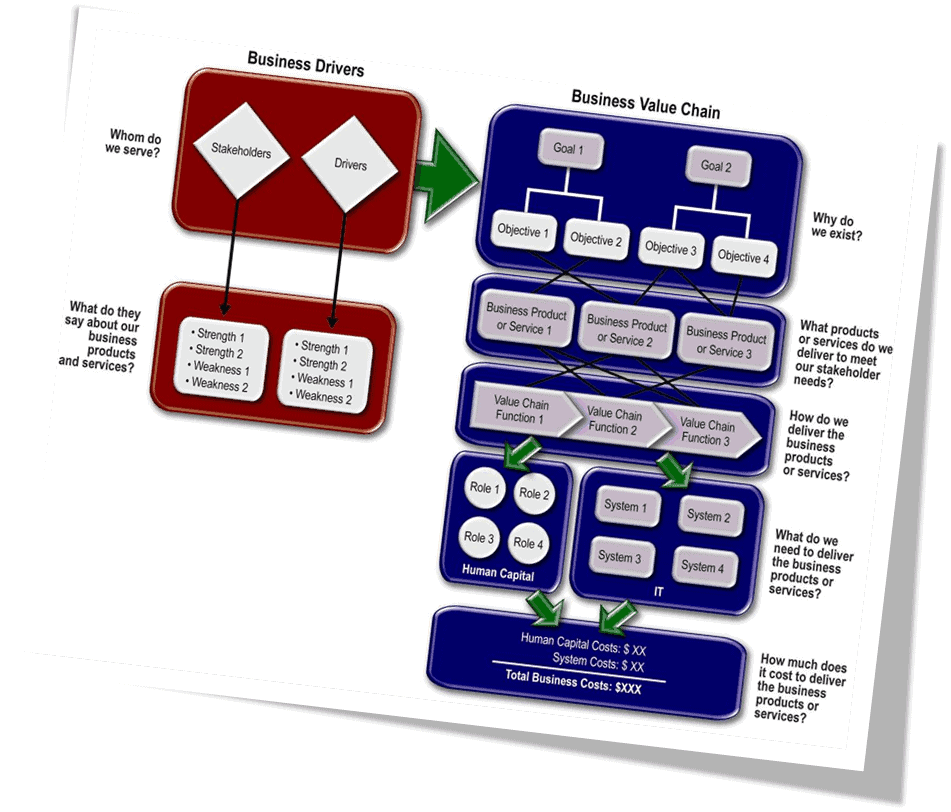
With a clear line of sight understanding, the core team can strategically seek opportunities to improve, analyze alternative ways to address, progress, or resolve issues and provide a key set of sequenced recommendations aligned with the organization’s capability to absorb the change and the organizations longevity factors for not addressing the change.
To establish the line of sight, the following expanded set of questions is designed to be utilized by the consultant and/or GenAI Socratic Facilitator, ensuring a comprehensive desk audit and initial gap analysis that fully addresses the preparation requirements. The FEA RM (Federal Enterprise Architecture Reference Models) Alignment columns categorize the focus area, which is critical for mapping the analysis outputs to the broader enterprise architecture (Activity 0.3).
I. Stakeholder Engagement & Purpose - Mandate/Analysis Goals
Focus Area | Question | FEA Alignment |
Executive Mandate | Who is the Executive Sponsor? What are the key decisions they need this analysis to inform (e.g.,product/service, funding, platform choice, operational change)? | PRM (Oversight) |
Users/ Customers | Who are the primary end-users and customers of the anticipated capability? What is their current perception of the need? | BRM |
Strategic Drivers | What are the core strategic plans, legislative mandates, or high-level organizational goals that necessitate this solution now? What external inputs (auditing, political, federal guidance, research) are driving these objectives? | PRM (Mission/Goals), BRM |
Business Needs | What three critical business problems (pain points) is the solution hypothesized to solve? How do these problems relate to the agency's core Lines of Business? | BRM |
CIO/IT Role | What is the long-term role envisioned for the CIO/IT/CDO team regarding this capability (e.g., service provider, operational oversight, or project management)? | Management, BRM |
Success Definition | What is the immediate, high-level Success Definition (Solution Objectives Abstract)? (e.g., Reduce time for regulatory compliance checks by 40%). | PRM (Outcomes) |
II. Scope, Boundaries, and Constraints - Foundational Readiness
Focus Area | Question | FEA Alignment |
Scope In/Out | What specific Lines of Business, geographies, or organizational units are definitely IN scope for the analysis? What is immediately OUT of scope? | BRM |
Related Initiatives | Are there any existing or planned digital transformation initiatives, cloud migrations, or data modernization efforts that this BCA must align with or avoid? | BRM, TRM |
Data Maturity | What is the current assessment of data readiness for the proposed use cases (e.g., data quality, security classification, accessibility)? | DRM |
Data V's | What is the current scoring/assessment of the 5 V's (Velocity, Variety, Veracity, Volume, Values) relevant to the target data sets? | DRM |
Data Owner | Who is the official Data Steward / Custodian for core data sets required? | DRM |
Technical Constraints | Are there any hard technical constraints or legacy systems that must be integrated, or specific platforms (e.g., AWS, GCP, Azure, on-prem) mandated by IT policy? | TRM |
IT Maturity | What is the maturity of the existing IT environment relevant to this analysis (e.g., R&D phase, live operations, 24x7 live operations)? | TRM |
Data Platform | Does the organization have Data platforms investments (e.g. MIS, GIS, Cloud, Analytics, DaaS, SaaS, BI, etc.) | TRM |
III. Preliminary Planning & Governance - Initial Mobilization Needs
Focus Area | Question | FEA Alignment |
Time Drivers | What external or internal deadline/event (e.g., audit date, budget cycle, policy change) dictates the analysis completion or solution deployment date? Are there any event triggers that can be leveraged to create momentum? | Management |
Required Roles | What key roles are immediately missing for the analysis team (e.g., Data Scientist, Enterprise Architect, Business Analyst)? Are these internal or contract roles? What is the strategy to evolve this capability over time (organically, incrementally)? | Human Capital |
Technology /Service Gaps | What core service capabilities (e.g., Cloud, AI, Analytics, Enterprise Data Tools, Security, GIS, compute/storage/network limitations) are known to be missing or insufficient today to support the potential solution? | SRM, TRM |
Solution Design | Is the solution primarily for dashboards, push reports, interactive apps, or visualization? Is responsive design needed across different devices? | SRM |
Risk /Mitigation | What are the top three risks to the analysis itself (e.g., lack of SME availability, shifting scope, budget uncertainty)? | Management |
Investment Justification | What is the Rough Order of Magnitude (ROM) ceiling for the analysis that needs immediate executive sign-off? | Management |